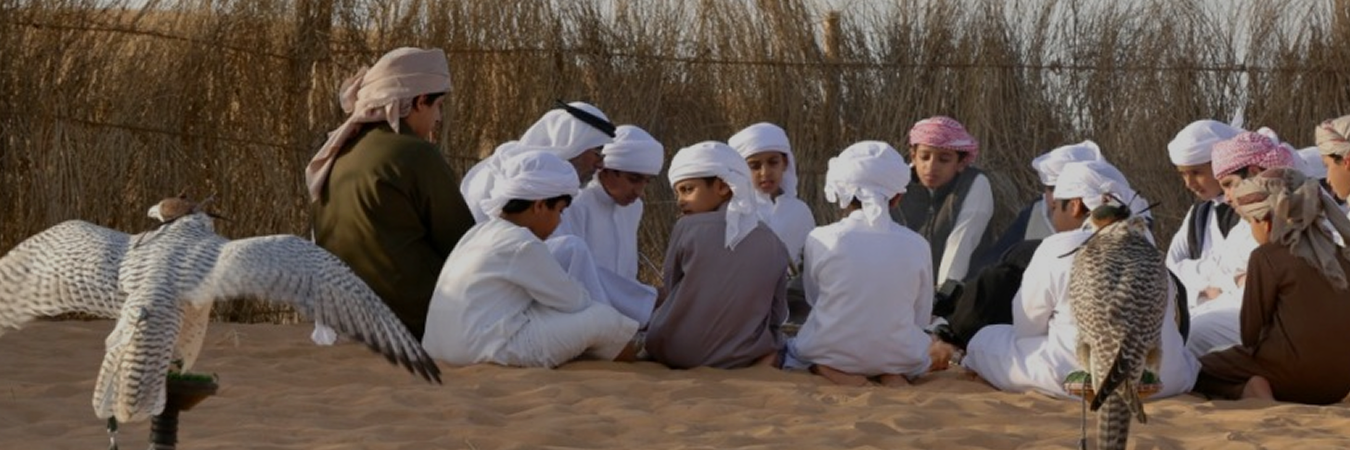
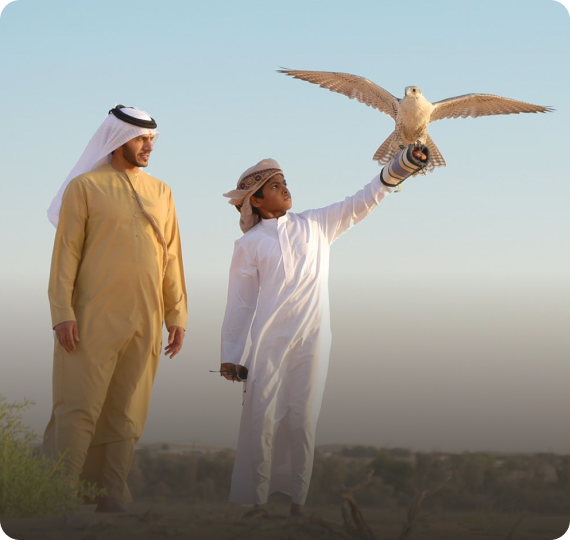
Falconry in the desert has long been intertwined with the close relationship between humans and nature and with the Bedouin way of life. Over the centuries, it evolved into one of the most prominent pillars of Bedouin culture in the Arabian Peninsula. During Megnas (traditional hunting expeditions), falconers acquired a wealth of experience by reading the terrain, observing the movement of the wind, tracking signs, navigating by the stars, observing falcons, and understanding the behaviour of prey. These experiences formed a comprehensive system of knowledge and values that shaped an important aspect of life in the desert.
For the Bedouin, the falcon was not merely a means of hunting but a trusted companion, cared for and valued through a relationship built on trust, patience, and an understanding of its temperament. Over time, this bond became a symbol of harmony between humans and nature, embodying the values on which life in the desert was founded.
The practice of falconry also instilled a strong sense of responsibility, discipline, careful observation, and sound judgment, while fostering respect for the ecological balance on which the success and continuity of Megnas depend. Across generations, falconry has remained a school of life, teaching people how to preserve nature and make use of its resources with care and respect for their conservation.
This knowledge was passed down from one generation to the next until falconry became part of the cultural identity of the United Arab Emirates and a human heritage inscribed on UNESCO’s Representative List of the Intangible Cultural Heritage of Humanity.
At the Mohamed Bin Zayed Falconry and Desert Physiognomy School, students rediscover this enduring bond between falcons and the Bedouin through an educational experience that combines study with practical application. The programme introduces them to the cultural and human significance that has made falconry not only a skill, but also a shared language connecting people with their environment and heritage.